
A brutal war, which crosses a historic threshold
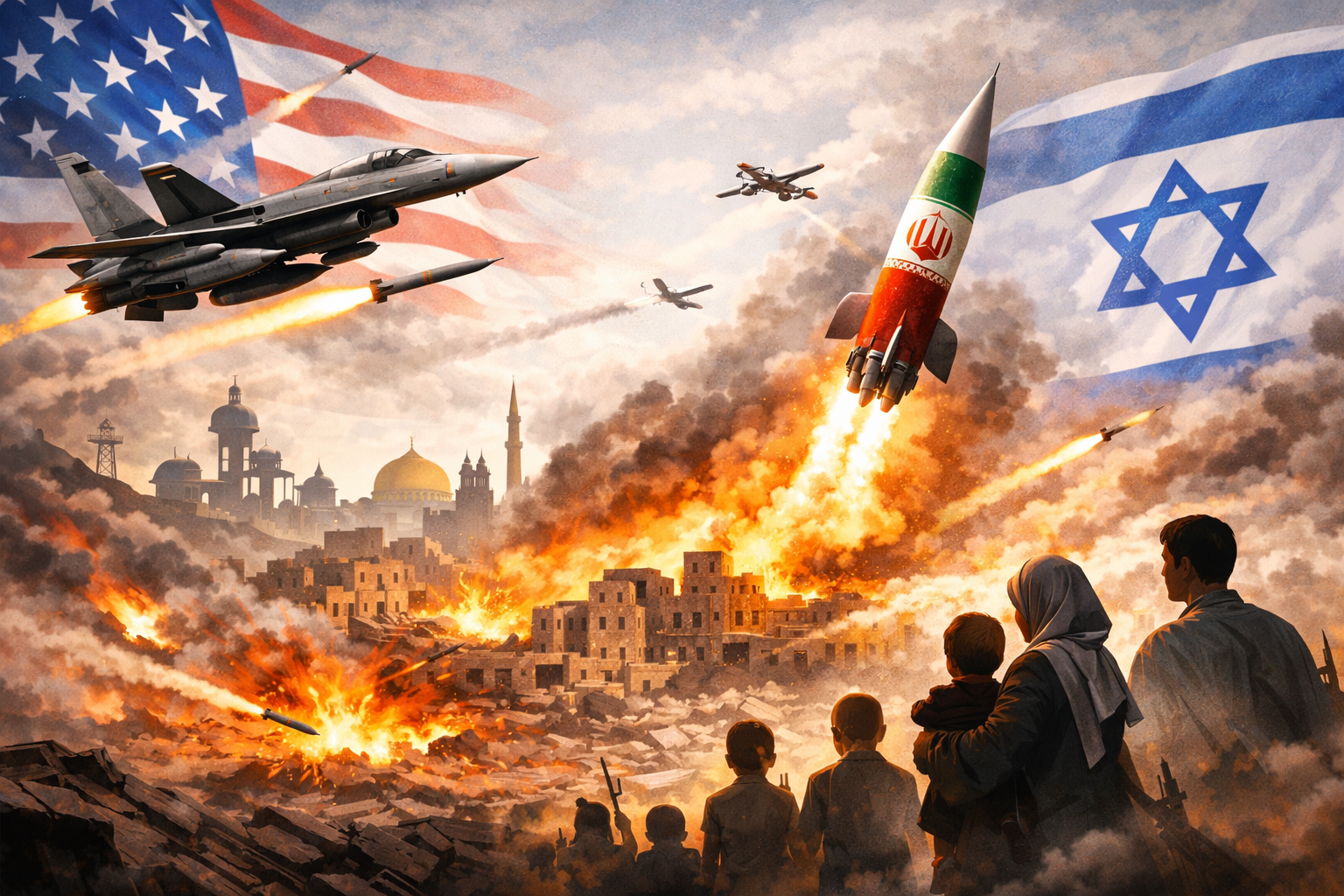
February 28, 2026, a new phase of confrontation begins in the Middle East, like the previous upheavals which continue. The United States and Israel launch a vast campaign of air strikes against Iran, targeting “military and strategic” infrastructure.
According to the American authorities, several thousand targets would have been attacked. struck in a few days (Pentagon, March 2026 cited by Reuters and associated Press).
The Iranian response is not long in coming: missiles and drones are sent to Israel and American bases throughout the Middle East.
Very quickly, the conflict goes from a simple episode of regional tensions to a serious one. a major international crisis, likely to ignite the entire region.
upgrade; the champion of international law
Since 1945, the rule in international law has been clear: the use of force is prohibited in international relations.
This principle is enshrined in Article 2§4 of the Charter of the United Nations.
Only two exceptions exist:
- Self-defense in the event of armed attack (article 51)
- Security Council authorization.
However, in the current context,
- no Security Council resolution. The United Nations has not authorized military intervention against Iran
- the USA and Israel are not in a self-defense position either
The justification for the attack is essentially based on the argument of legitimate preventive defense, invoked by Israel and the United States, facing each other what he considers to be an Iranian strategic threat.
But this doctrine of legitimate preventive defense is extremely contested in international law. Indeed, the jurisprudence of the International Court of Justice generally requires the existence of an actual or imminent armed attack.
There is therefore « violation of international law by the United States and Israel.
>a war that weakens order international
Beyondà From the legal question, this crisis reveals a reality deeper: international law is struggling to achieve its goals. regulate the use of force when the great powers are involved.
Since the end of the Cold War, several military interventions have already taken place. bypassed UN law:
- The Kosovo War in 1999
- The Iraq War in 2003
- The war in Libya in 2011
- The war in Syria in 2014
Each time, the arguments invoked were different: humanitarian intervention, fight against terrorism, responsibility for human rights. to protect or safety national.
But the result is the same: progressive erosion of the principle of prohibiting the use of strength.
geopolitics
As in most modern armed conflicts, it is the civilian populations who pay the heaviest price.
Organizations like Human Rights Watchhave already done so. requested the opening of investigations into certain strikes that affected civilian infrastructure, including a school in Iran.
If these attacks were deemed indiscriminate or disproportionate, they could constitute violations of international law humanitarian, even war crimes.
>An escalation with global consequences important
This war is not just about the Middle East.
It has significant global repercussions that are already being felt. visible:
- Risk of blocking the Strait of Hormuz through which approximately 20% of the world's oil passes (US Energy Information Administration, 2024)
- Spiking global energy prices
- Geopolitical polarization between Western and rival powers
Clearly, this conflict could reconfigure the global strategic balance.
Recent history teaches us: when great powers go to war, international law often becomes a variable adjustment.
The war between the United States, Israel and Iran poses fundamental questions:
Is international law still capable of limiting war?
Better, international law really still exists? If so, are there only countries for so-called “weak” countries?
Because if the logic of preemptive strikes and unilateral interventions imposes itself lastingly – and generally due to so-called “strong” against so-called “weak” - then the international order does not exist in 1945 – background on the Charter of the United Nations – risks being transformed profoundly and giving way to reality oldest: the one where military power takes precedence over the rule of law.
And in a nuclear world, this evolution could be very severe dangerous.
The question is no longer just military or diplomatic; it is civilizational:
Will the 21st century be governed by by law… or by force?