
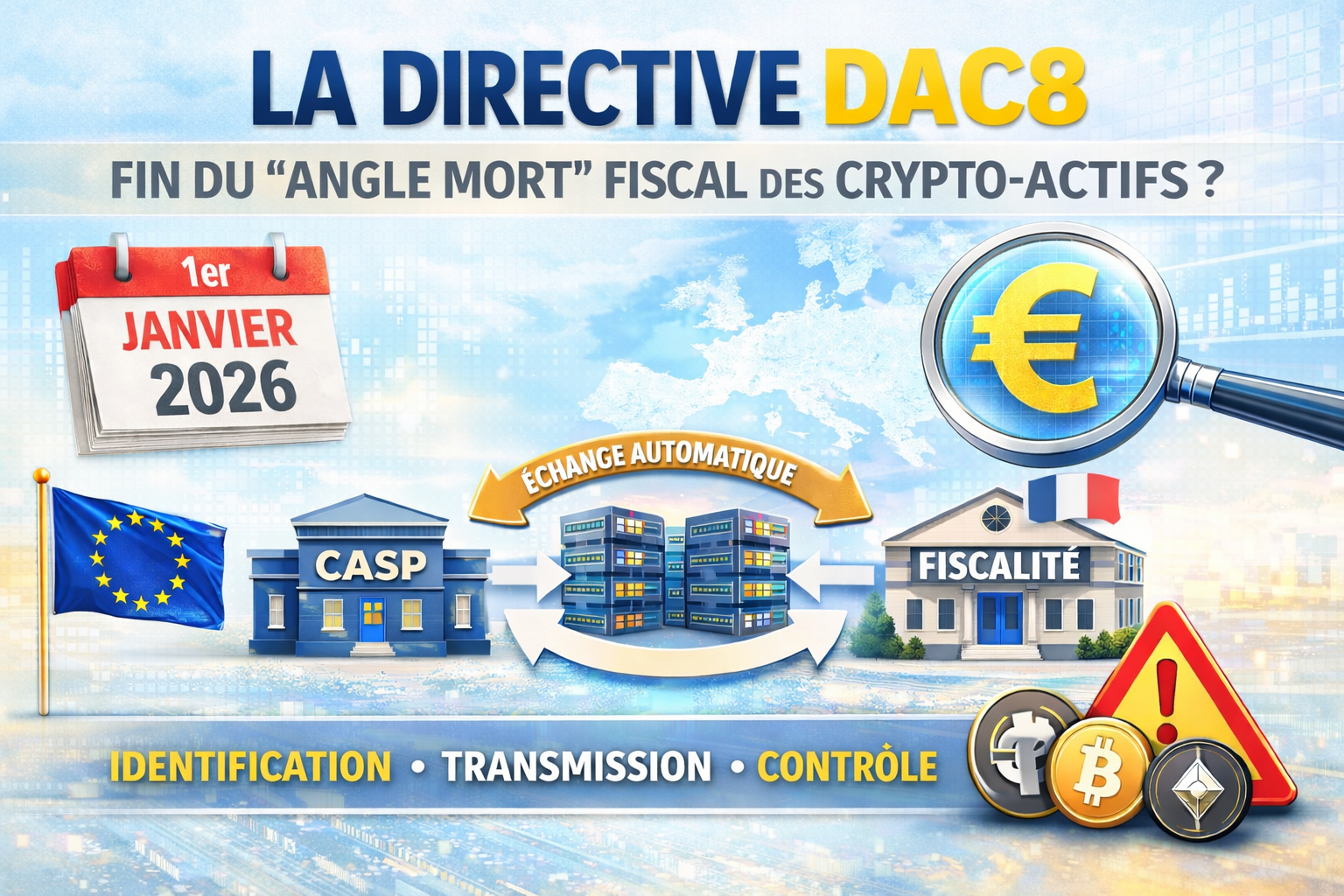
“Since January 1, 2026, the DAC8 directive has completed the European framework after MiCA by organizing the circulation of tax information on crypto-assets. CASPs will …
— Kahafoa Desiré Ouattara
THE DAC8 DIRECTIVE: Towards a possible end to the tax blind spot for crypto-assets?
Since January 1, 2026, the DAC8 Directive has entered into force. After the MiCA regulation, which endowed providing the European Union with a prudential and organizational framework applicable to issuers and crypto-asset service providers (CASP), the DAC8 completes the building by addressing what MiCA was not intended to do. to regulate: « the circulation of tax information.
This text, the eighth extension of the directive relating to administrative cooperation in tax matters, marks a decisive turning point: crypto-assets are now integrated into the European system for automatic exchange of information.
➢ DAC8: what exactly is it?
The DAC8 directive requires crypto-asset service providers (CASPs) established in the Union:
1. Formal identification of users,
2. Determination of their tax residence,
3. Collection of data relating to transactions, conversions and certain exchanges,
4. Transmission of this information to national tax authorities.
This data is then exchanged automatically between Member States according to a harmonized format.
The consequence is structural: a French tax resident using a platform located in another member state no longer benefits from any informational partitioning. The data will be transmitted to the French administration without prior initiative from the taxpayer.
We are moving from an essentially declarative model to a model based on information. on data and algorithmic correlation.
➢ A pre-existing tax framework, but until now imperfectly controlled
In French law, the regime for capital gains on digital assets is codified. à Article 150 VH bis of the General Tax Code. The generating event is strictly defined: conversion into legal tender, payment of a good or service in crypto-assets, exchange accompanied by a balance.
In addition, taxation is in principle subject to the single flat-rate levy of 31.4% (12.8% income tax and 18.6% social security contributions), with the possibility of changing the tax rate. option for the progressive scale. The plate as for it is determined using a proportional method based on the overall value of the portfolio, excluding any FIFO or LIFO logic. This mechanism, technically demanding, requires traceability. rigorous flow and integration of costs into the acquisition price.
The legal framework therefore existed. What was lacking was the ability to of cross-border control, in an environment that is by nature deterritorialized. The DAC8 corrects this dissociation between standard and capacity. detection.
➢ Neutrality tax and liability States
It is important to emphasize that DAC8 does not create a specific tax on crypto-assets. It enshrines a principle of neutrality; : comparable income must be subject to a comparable load, regardless of the underlying technology.
On the other hand, the massification of data exchanges imposes on States an increased requirement in terms of security. IT and personal data protection. Legitimacy tax transparency is based on the rigor of its technical and legal framework.
➢ A paradigm shift for the taxpayer
The question is no longer whether the administration can identify the operations.
She can. Any discrepancy between the amounts declared and the information transmitted by the platforms can be detected quickly. Non-declaration no longer falls within a technical gray area, it constitutes taking an objective legal risk.
In this context, security tax is based on three fundamental requirements:
1. Adequate legal qualification of flows: distinction between occasional capital gains, income from movable capital, professional profits (BIC/BNC) where applicable.
2. Complete documentation of operations, including inter-wallet transfers, fees, staking or lending operations.
3. Strict declarative consistency between actual economic flows and reported amounts.
The declaration of digital asset accounts opened at the foreigner is now part of an environment where the omission becomes easily detectable and, therefore, difficult to defend.
➢ After MiCA and DAC8, what will be the next step?
After the prudential framework established By the MiCA regulation and the informational transparency organized by the DAC8 directive, the tax control of crypto-assets is changing in nature: it is becoming automated, structured and structured. and systemic. The algorithmic crossing of declarative data with the flows transmitted by the platforms establishes continuous control, based on on the massive exploitation of data.
Will the next step be that of full management of tax control through data intelligence, where? compliance will have to be anticipated well before any intervention by the administration?
Cover image source: Axinfos, produced by AI