“What if the return of Macky Sall marked the start of a new political cycle in Senegal? Deciphering the balance of power and the challenges …
— BERE TOURE
« CAN THE REJECTED STONE BECOME THE MAIN STONE? »
This African quote, which evokes the revenge of a man on his destiny, invites you to reflect on the career of a leader who was one of the main architects of the transformation of Senegal, but whose name remains associated with the to the most serious political crises in the country's recent history.
Why does Macky Sall continue to arouse so much distrust more than two years after leaving the company? power? And why his announced return? does it already cause so many expectations, worries and speculations?
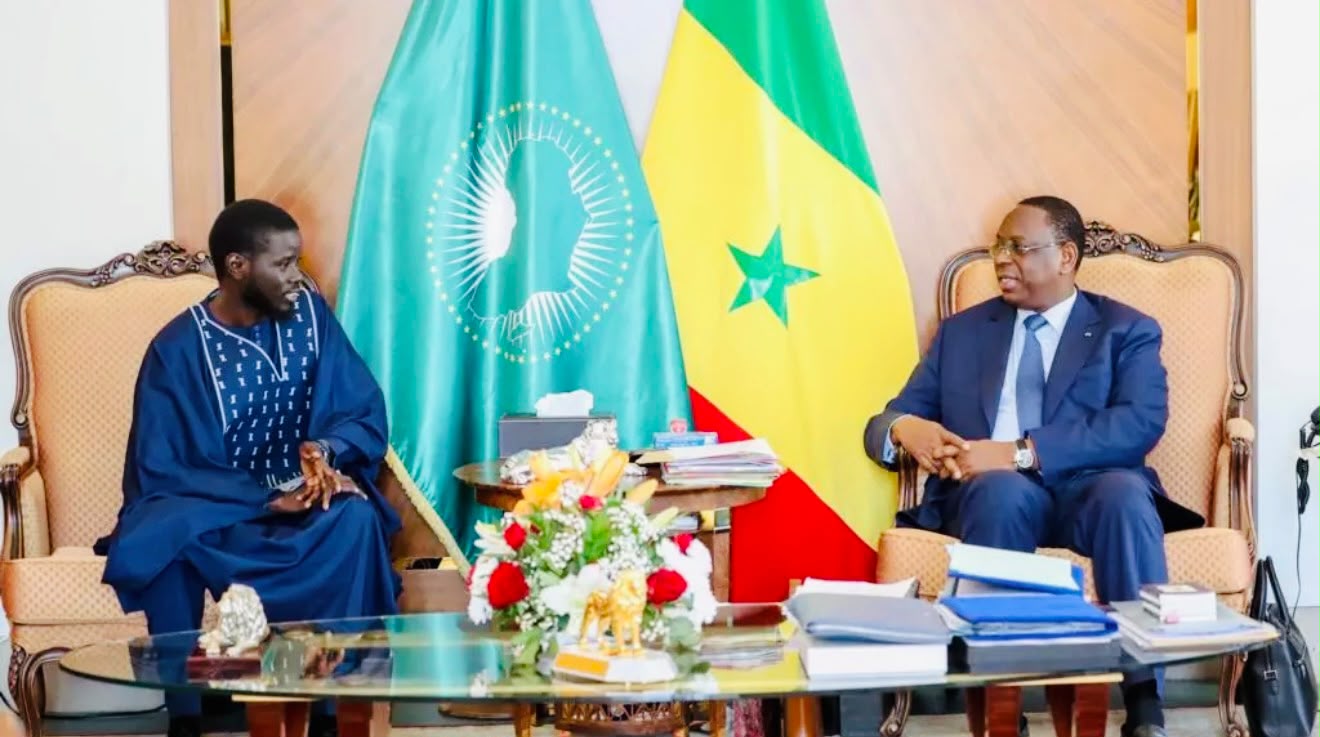
On July 17, 2026, the former president is scheduled to make his first public visit to Senegal since the transfer of power to Senegal. Bassirou Diomaye Faye in April 2024. Officially, this trip is part of his campaign to become secretary general of the United Nations. He must meet his successor before continuing his diplomatic consultations. Installed in Morocco since his departure, Macky Sall also announced that he would then return to Dakar to find his supporters.
À At first glance, it is just an institutional visit. However, in politics, the calendar sometimes transforms a simple trip into an event.
Macky Sall returns in a new context. The power resulting from the alternation of 2024 has gradually fractured. Bassirou Diomaye Faye and Ousmane Sonko, long presented as the two faces of the same project, now embody two centers of power.
Sonko left; the Prime Minister to take the presidency of the National Assembly, where PASTEF retains a solid majority. Face to face him, Diomaye Faye heads the executive and seeks to improve his position. build your own political base. The differences relate as much to economic orientations as to ambitions for 2029, political funds or even the conception of authority. presidential election. The rupture became institutional when the majority parliamentarian adopted a reform aimed at strengthen the powers of Parliament, create a Constitutional Court and further limit the presidential power to dissolve the Assembly. Bassirou Diomaye Faye appealed to the Constitutional Council, which ultimately rejected the decision. the text. The image was striking: the president asked the judges to annul a reform voted for by the majority of judges. resulting from the movement which had carried it in power.
It is into this breach that Macky Sall returns.
He may not be coming back to regain power. But his presence alone could be enough to solve the problem. modify the balance of power which now structures Senegalese political life.
A MAN REJECTED, BUT NEVER POLITICALLY ERASE
Macky Sall left the presidency in a climate of hostility which seemed to condemn him to a long crossing of the desert. However, he does not return without resources.
He remains the founder and leader of the Alliance for the Republic (APR). If the party lost power in 2024, it retains elected officials, experienced executives, a solid territorial anchor and the legacy of twelve years of exercise of power. From March 2026, Macky Sall relaunched its restructuring by requesting its leaders to put the party back in battle order. The welcome prepared for his return also aims at demonstrate that his leadership remains intact.
Its influence is also based on a material balance sheet that is difficult to assess. delete.
Arrival in power in 2012, he made infrastructure, energy and attractiveness a priority. economic the pillars of the Senegal Plan emerge launched in 2014. The regional express train, the Bus Rapid Transit, the highways, the new town of Diamniadio and even energy investments have profoundly transformed the economy. the territory, particularly around Dakar.
The BRT, inaugurated in 2024, has become the first fully electric rapid bus network in Africa. According to the World Bank, it can transport nearly 300,000 travelers per day and reduce certain journeys between Dakar and Guédiawaye from 95 to 100,000 passengers per day. 45 minutes. The same institution also recalls that Senegal has recorded more than 6% annual growth for five consecutive years before the pandemic.
These achievements do not erase inequalities or social difficulties. They nevertheless offer Macky Sall a concrete political argument: that of a state which planned, invested and built in the long term. À as the current power comes up against budgetary constraints, social expectations and its own divisions, this image of a builder can find a certain echo with a part of public opinion.
The return of Macky Sall cannot, however, be presented like that of a man whose rehabilitation would already be over. acquired.
The last years of his power profoundly deteriorated. its relationship with part of society; Senegalese. À From 2021, the arrest of Ousmane Sonko in the Adji Sarr affair provoked several waves of demonstrations. The authorities then denounce attempts at insurrection, while the opposition accuses the government of using justice to remove its main adversary. The clashes, the restrictions imposed on demonstrations and the cuts to certain means of communication have permanently severed the link between power and part of the youth.
À To this crisis was added the uncertainty surrounding a possible third application. Macky Sall finally renounces it on July 3, 2023, but his prolonged silence continues. already had fueled distrust.
Then, in February 2024, he announced the postponement of the presidential election, citing protests over the electoral process. The Constitutional Council annuls this decision and imposes the holding of the vote before the end of its mandate. This episode remains one of the most controversial of his political legacy.
After his departure, criticism shifted to the management of public finances.
The audits revealed a significant undervaluation of the deficit and debt. The IMF provisionally estimates central government debt at 105.7% of GDP at the end of 2024, with a budget deficit of 11.7%. Audits carried out by the Senegalese authorities, the Court of Auditors and an international firm led the Fund to open a procedure for erroneous declaration of public data. Macky Sall rejects these accusations, as do several former officials of his administration.
These controversies make any consensual image of the former president difficult. They explain why his return could mobilize his support as much as revive the opposition of his detractors.
But they do not erase his influence. They make it more divisive.
However, in a political landscape that is now fragmented, a divisive influence can also become a negotiating lever.
APR, POSSIBLE TRACT D’UNION OF THE NEW POLITICAL ORDER
The real question is therefore not whether Macky Sall can become president again. The Constitution and the political context make this hypothesis unlikely. The issue is elsewhere: what can he still do with the political apparatus he built?
Since the breakup between Bassirou Diomaye Faye and Ousmane Sonko, two poles have sought to find a solution. impose yourself.
The first is that of PASTEF, directed by the by Sonko, who retains a solid majority; parliamentary, a strong activist presence and a sovereignist discourse.
The second is built around the President of the Republic. Bassirou Diomaye Faye now intends to structure her own political organization in order to carry her line and expand her majority. beyond of PASTEF. But this future presidential center will need local, experienced relays and a political apparatus capable of occupying the field. This is precisely what the APR still has. No official rapprochement between Macky Sall and Bassirou Diomaye Faye has been established today. Such an alliance would also be politically delicate: Diomaye Faye was Elected on the promise of breaking with the system embodied by by his predecessor. However, several APR officials are already talking about this. rumors of contacts between the two camps. Their simple circulation reveals that the hypothesis of a political recomposition is now taken seriously.
An open alliance seems unlikely at present. short term. On the other hand, occasional convergences are possible: parliamentary cooperation on certain texts, individual rallies of former APR executives, agreements during local elections or the creation of a front favorable to the maintenance of a strong presidential regime.
In this configuration, Macky Sall would act less like the leader of a new majority. as the holder of a still indispensable political network. The APR could bring to the presidential camp what it lacks: a territorial presence, governmental experience and officials capable of structuring a majority. sustainable.
In return, a rapprochement would also offer the APR a way out after its defeat in 2024. The party would regain a capacity to influence without having to immediately initiate a reconquest of power.
This strategy, however, carries risks.
For Bassirou Diomaye Faye, that of disappointing the voters who had voted to break with the old regime.
For Macky Sall, that of appearing as the man of compromise rather than as the man of unity.
For the APR, that of gradually losing its identity by becoming a simple auxiliary force.
Finally, for Ousmane Sonko, the emergence of an axis bringing together part of the presidential camp and former APR officials would undoubtedly constitute the most serious political challenge since the alternation of 2024.
Everything will now depend on the posture that Macky Sall chooses.
If he returns as the leader of a certain camp à transforming the difficulties of the current power into political revenge, it will undoubtedly consolidate the APR. But it will also reinforce the narrative defended by Ousmane Sonko: that of an old system which seeks to improve itself. take back what the voters took away from him.
If he limits his return to After his campaign for the general secretariat of the United Nations, his influence on the national scene will remain essentially symbolic. Its international image could be strengthened, without changing the Senegalese political balance.
A third way, however, remains possible: that of the arbitrator.
Macky Sall could restructure his party, encourage dialogue with the new authorities and contribute to the emergence of a republican opposition capable of weighing without seeking to govern immediately. Such a posture would be consistent with its international ambition: those who aspire to To lead the UN should first demonstrate his ability to à promote appeasement in your own country.
This scenario would not make him the savior of Senegal. No former president can claim to alone repair the fragilities of a democracy that he himself led for twelve years. On the other hand, it could become one of the players capable of avoiding rivalry. between the presidency and the majority parliamentary action does not lead to a lasting blockage of institutions.
Senegal would then enter a new political configuration: Ousmane Sonko to; the head of a dominant PASTEF in Parliament; Bassirou Diomaye Faye around a presidential movement under construction; and Macky Sall à; the head of an old formation, but still sufficiently structured to influence future alliances.
The announced return of July 17 is perhaps, in appearance, only a diplomatic step. However, he intervenes at the moment when the Senegalese political system is seeking a new balance. Sometimes all it takes is a presence, a few signals and a favorable political window to accelerate recompositions so far. unimaginable.
Not necessarily to find the presidential chair.
No more to erase the wounds left by his exercise of power.
But perhaps to remind you that in politics, a man never completely disappears as long as the party he built, the achievements he claims and the networks he continues remain. to influence.
« Can the rejected stone become the main one? »
Maybe.
But it will become so neither through nostalgia nor through the difficulties of its adversaries. She will have to convince that she can still contribute to the future. stability of the political building without seeking to substitute for it.
The real issue of this return will therefore not lie in the welcome reserved for à Macky Sall, but in what follows: the strategy that he will imprint on the APR, the nature of his relations with Bassirou Diomaye Faye and the response that Ousmane Sonko will give to this new deal.
It’s here. what will be the real significance of his return.
Not in the past; which he still embodies, but in the future he could contribute to shape.