Obama and the « reset » with Moscow: the hope of a new balance (2009)
As soon as he arrives at At the White House on January 20, 2009, Barack Obama made the relationship with Russia and nuclear arms control a priority. diplomatic. In July 2009, he went to Moscow to meet President Medvedev and Prime Minister Vladimir Putin with the stated intention of « reset » relations between Washington and Moscow. A few months earlier, in April 2009, Obama had declared wanting to include his mandate in the quest « "A world without nuclear weapons," saying the United States would negotiate a new nuclear weapons treaty. reduction of strategic weapons with Russia. À During the same period, Moscow adopted a posture of caution mixed with firmness. : Medvedev announced a vast rearmament in order to “ to increase the capacity combat capabilities of our forces, above all those of our strategic nuclear forces ».
New START: birth of a last safeguard (2009–2011)
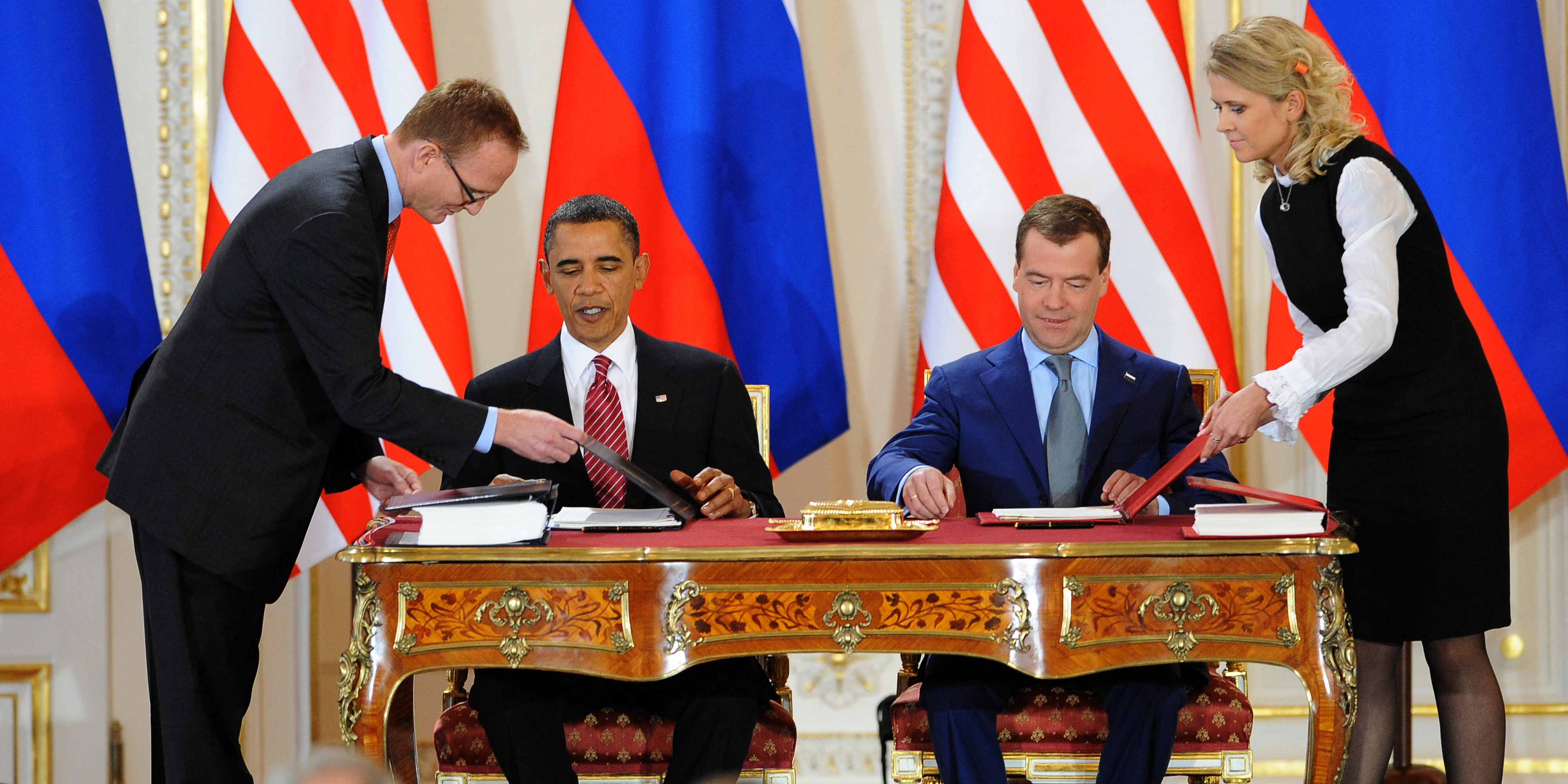
Negotiations really open at the G20 summit in London. London in April 2009, where the two heads of state sign a memorandum of understanding paving the way for a treatise complete. New START will finally be signed in April 2010 and will come into force on February 5, 2011. It limits to 1,550 the number of nuclear warheads deployed and strictly supervises strategic launchers, with an unprecedented inspection regime inherited from the achievements from the end of the Cold War. This framework, already weakened by the deterioration of Russian-American relations, changes in 2023 when Moscow announces suspending its participation, putting an end to inspections and data exchanges, even if Russia then claims to continue to do so. voluntarily respect the limits of the treaty.
After-processing : a first since 1972, a total legal vacuum
Today, with the official expiration of the treaty, the two largest nuclear arsenals in the world find themselves without any legal safeguards for the first time since 1972. This disappearance occurs in a marked international context. by the erosion of peace mechanisms, by the return of logic of confrontation and by the multiplication of what we call frozen conflicts, which heat up under the effect of ever more frank rivalries. Ukraine, the Caucasus, the Sahel, Asia-Pacific: so many theaters where strategic competition between great powers is brutally reshaping the world scene.
Return of Cold War logic: indirect rivalries and polarization
The United States and Russia remain the two greatest military powers on the planet; they are also the main political-military supporters of their respective allies. In this configuration, their rivalry never limits itself to a face-to-face encounter: it irrigates regional fault lines, fuels indirect escalations and reinforces the mechanisms of geopolitical polarization. The current situation is inevitably reminiscent of the dynamics of the Cold War, when Washington and Moscow confronted each other through intermediary countries and the arms race constituted the main lever of the demonstration of power. History never repeats itself again and again. identical, but the springs which animated the strategic competition from the 1950s to The 1980s seem to have reappeared, this time in a more fragmented, less predictable and devoid of global environment. stabilizing frames laboriously constructed after the fall of the USSR.
The shock of 2022: the breakdown of the security system European
To understand this return of uncertainty, we must remember that in February 2022, the West suddenly discovered the fragility of the world. of the security system who had ensured more than 70 years without major conflict on the European continent. Russia’s invasion of Ukraine revealed that peace rested less on a lasting balance than on a constantly renegotiated balance of power. When this balance of power breaks down, the weapons return to their place at the center of the game. The expiration of New START, the last legal barrier between the two largest nuclear arsenals, is part of this shift: it confirms that the international security architecture is no longer capable of regulating the dynamics of power.
Europe facing Europe History: strategic actor or adjustment variable?
From then on, a central question arises: what place for Europe in this climate of global uncertainty? The continent, more of a spectator than an actor in nuclear matters, nevertheless finds itself on the front line of the strategic consequences of this new era. Between the continued dependence on the American umbrella, the need to to strengthen its own defense capabilities, and the imperative to exist diplomatically in a world dominated by foreigners. by the Sino-American confrontation, Europe must rethink its posture. Without treaty to control the arsenals of the United States and Russia, without guarantee that the logic of de-escalation will prevail, and without certainty about the constancy of its allies, it finds itself faced with a responsibility of its own. historical: choose whether it wants to be a strategic player or a simple variable in the global game.
A major political signal: the world is leaving the era of rules
The disappearance of New START is not just a technical event in the field of arms control. This is a major political signal, that of a world that is moving away from rules, agreements and mechanisms of mutual trust. A world where balance rests less on cooperation than on the ability to respond. of deterrence. A world where peace is perhaps no longer the absence of war, but the expression of a constantly reassessed balance of power.
The final question: lucid Europe or worried Europe?
In this strategic recomposition, the voice of Europe will only be able to count if the continent agrees to take the full measure of the moment. The expiration of New START reminds us that when the great powers stop talking to each other, it is the margins of the world that burn first. Rest at know whether Europe will choose to be a lucid actor or a worried spectator of this new nuclear age.
Cover photo source: The signing of the treaty "New Start" by the American presidents Barack Obama and Russian president Dmitri Medvedev, on April 8, 2010 at Prague - JOE KLAMAR / AFP